This article contains affiliate links. If you buy through them, I may earn a commission at no extra cost to you. As an Amazon Associate I earn from qualifying purchases.
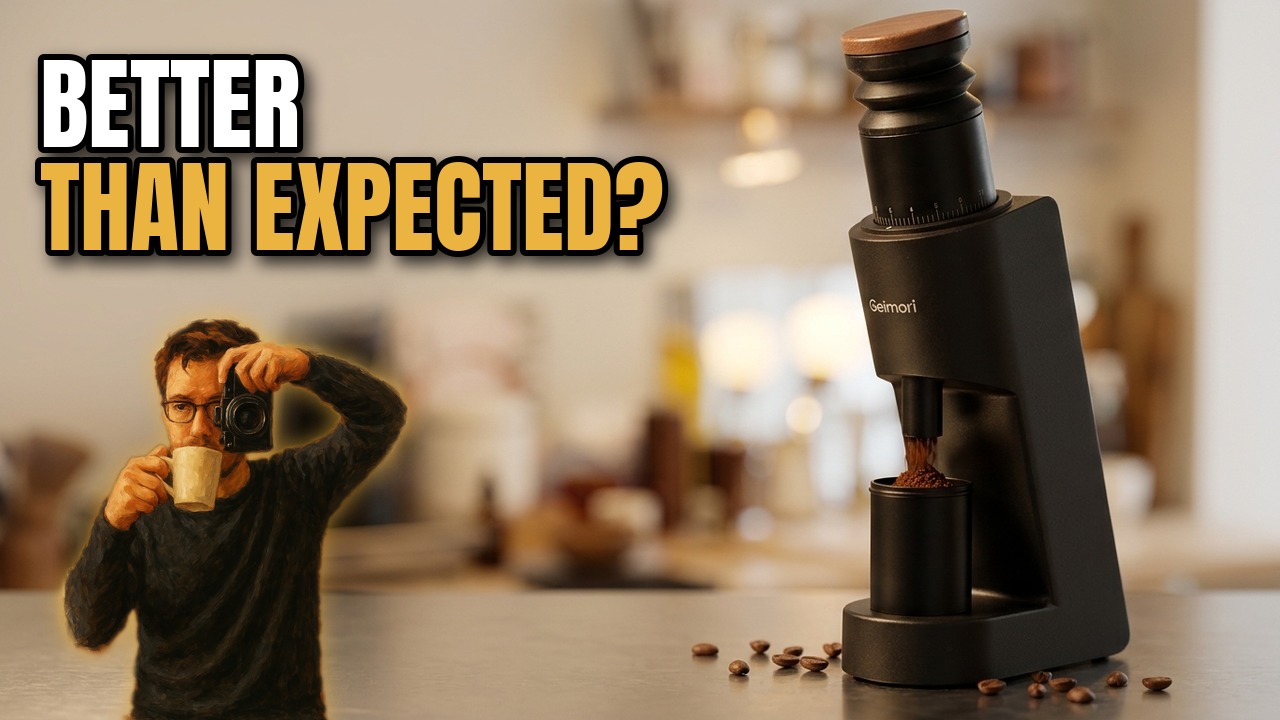
A 38 mm burr for a bit over €160. When the Geimori GU38 arrived, I had my doubts. Six weeks and a bunch of measurements later, I don’t. Apart from speed, its numbers are ones I usually see from much more expensive grinders. Over the past few weeks I reached for it in the morning more often than for my Eureka Mignon Single Dose, which cost around €600 when I bought it. It isn’t perfect, though. It’s slow, and there’s one catch in daily use.
Disclosure: Wirsh, the company behind Geimori, sent me the grinder for free. It arrived on September 12. Since then nobody at Wirsh has had a say in the review, and there was no deadline. The link and the code coffeexris in this post are affiliate. If you buy through them, I get a small commission.
My verdict after six weeks
- Espresso. Dense, with lots of body and a soft texture. For espresso, the GU38 is the best grinder under €200 I’ve tested so far.
- Speed. Its weakest point. 20.5 g take 72 seconds at a very fine setting.
- The catch. Every time I grind, beans get stuck at the top of the hopper and I push them down by hand.
- Filter. It works, but with less clarity than my Eureka.
- Price. A bit over €160 in the shop, 15 percent less with the code coffeexris, plus shipping.
Measurements at a glance
I measured at home, with a light roast at my usual setting for a high extraction basket.
| Measurement | Result |
|---|---|
| Grind time | 72 s for 20.5 g at a very fine setting, step 5 |
| Temperature | Grounds at 26 °C, beans at 20.4 °C before grinding |
| Noise | 74 to 75 dB, Apple Watch at 20 cm |
| Retention while grinding | 20.5 g in, 20.5 g out, with a water spritz and the bellows |
| Left inside after a teardown | 0.3 g |
Speed. Wirsh quotes 0.6 g per second for espresso. At my very fine setting I get less than half of that. At a coarser espresso setting it’s faster, and other reviewers measure half a minute or more. For one coffee in the morning I don’t care. If you make three espressos in a row for guests, it gets long.
Temperature. If the grounds get too warm while grinding, they lose aroma before they even reach the portafilter. With the GU38 they went from 20.4 °C bean temperature to 26 °C, measured after one dose. That’s where the slow motor pays off.
Noise. The Apple Watch is not a calibrated meter, but 74 to 75 dB at 20 cm is not loud for an espresso grinder.
Retention. What impressed me most is how little coffee stays in the grinder. 20.5 g in, 20.5 g out, and my scale shows zero. The manufacturer promises under 0.1 g. That’s with a spritz of water and the bellows. I didn’t measure without them, because that’s how I use it.
Left inside after a teardown. After a few weeks I took the grinder fully apart to see what stays in the gaps and on the burrs for good. You unscrew the adjustment collar at the top and the burrs are exposed. No tools needed. You lose your grind setting, but the numbers on the dial get you back quickly. After brushing everything out, 0.3 g were left. Another GU38 review found more retention after a few months. After six weeks I see none of that. I’ll report back once I’ve had it longer.
Burrs and build
Inside sits a 38 mm conical burr. That’s about the size of the burr in a Comandante, a hand grinder that costs more than the whole GU38. My Eureka has 65 mm flat burrs. On paper that’s a big gap, which is why I was skeptical.
Instead of burr size, the GU38 bets on going slow. It spins at 170 rpm, and the Niche Zero at nearly twice that. Slower means less heat and a more even grind. It also means you wait.
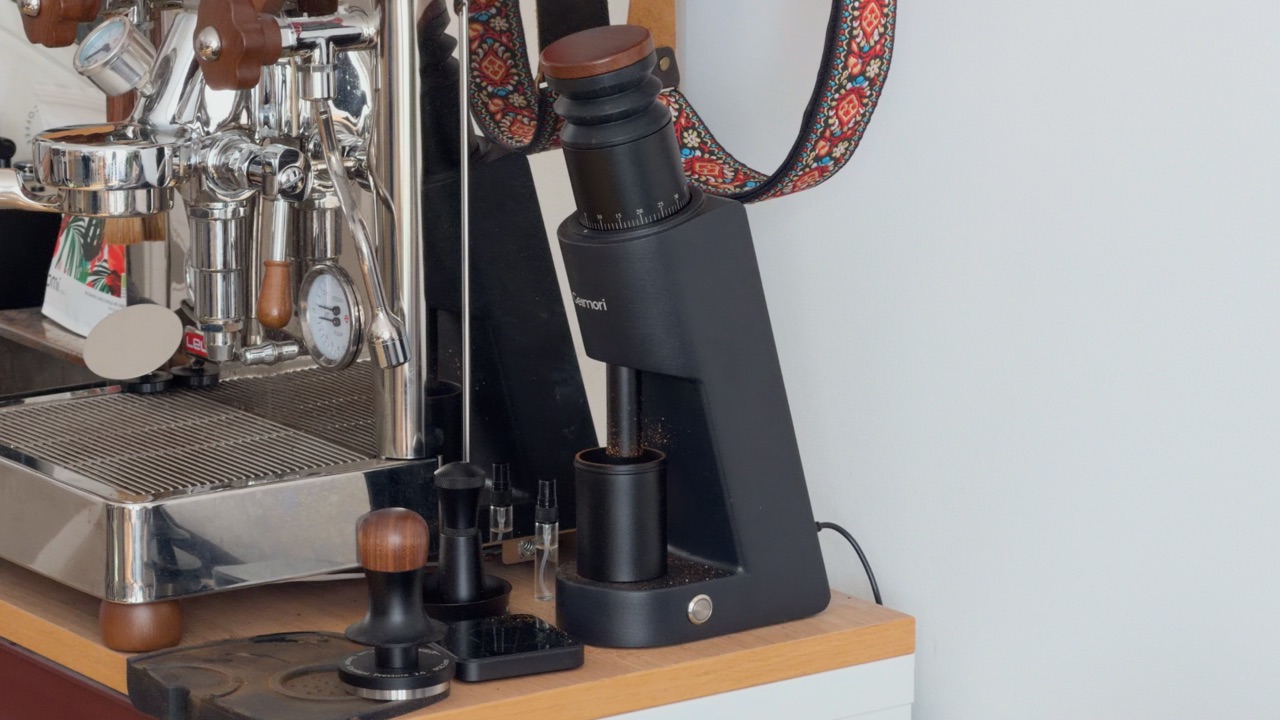
The body is die-cast aluminium. The whole grinder weighs just under 2.5 kg and is only 9 cm wide, so it barely takes up space next to an espresso machine. Power comes from an external brick, like a laptop. If you know the Varia VS3, the shape will look familiar. The GU38 comes in white and black, I like both, and after six weeks of daily use mine still looks brand new.
Grind range: plenty of room at the fine end
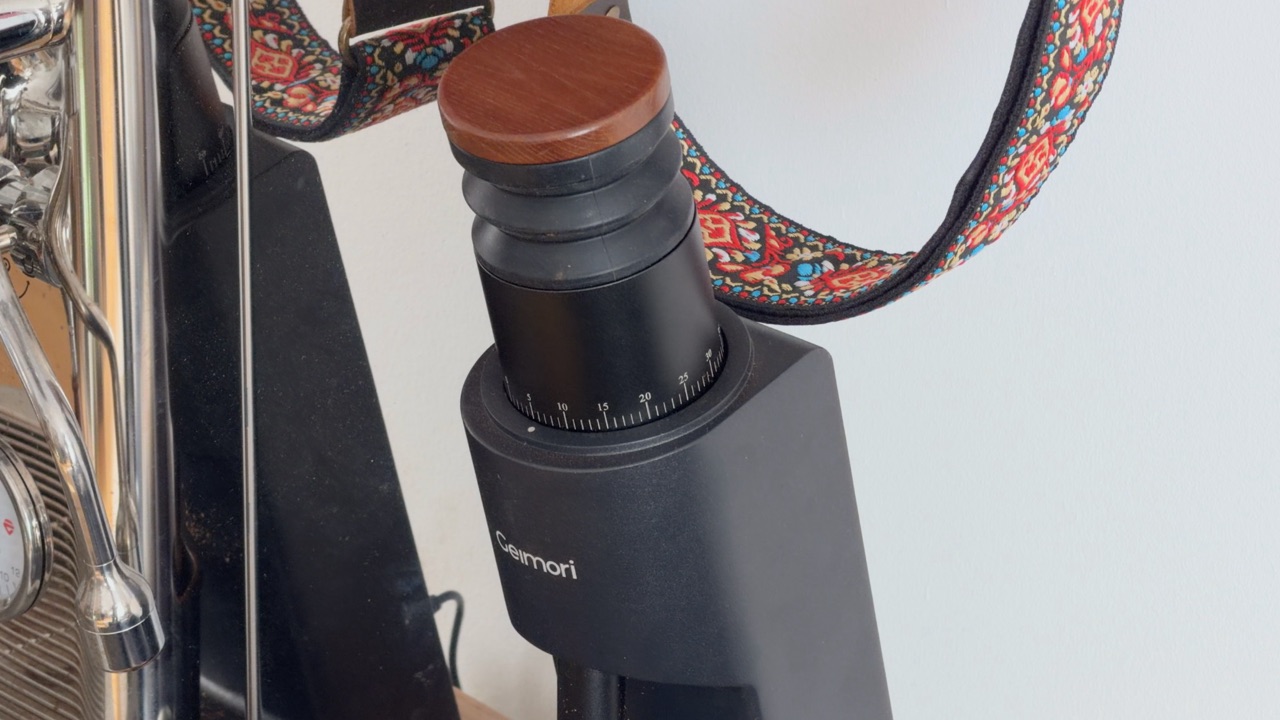
You adjust the grind steplessly at the collar on top, on a scale from 0 to 65. According to the manufacturer, one mark equals 20 micrometers. The thread has a nice bit of resistance, so you can hit the small steps espresso needs.
For my light roast espresso in a high extraction basket I ended up between 3 and 5, right at the fine end. There’s room left, even for very light roasts. At settings that fine, some grinders simply stall on hard, light beans. The GU38 didn’t stall once in six weeks, and light beans are most of what I grind.
The numbers are easy to read. If the grinder sits on a low shelf, though, you have to crouch, because from above you can barely see them.
Under the first video someone asked whether it goes fine enough for a moka pot or Turkish coffee. For a Bialetti, easily, since that needs a coarser grind than espresso. I haven’t tried Turkish coffee. If you need to go finer than my espresso, I’d advise against it. Grinding to flour is a lot of work for a small burr, and I wouldn’t put the grinder through that long term.
Daily use and the catch
I mostly grind espresso, and this is what a morning with it looks like. I weigh 20.5 g of beans and give them a spritz from the little bottle against static. Beans into the hopper, press the button, and it starts right away.
Then comes the one thing that really bugs me day to day. A lid sits on top of the hopper, and it has to stay on while grinding, or beans jump out. Up in the hopper, though, beans get stuck. Not now and then, every single time. I push the last ones down with my WDT tool, so you end up standing next to it and helping. Other reviewers poke at the exact same spot. I can live with it, but you should know before you buy.
When nothing else comes out, you switch it off yourself. There’s no auto stop. Then a few pumps on the bellows. Push too hard and it rocks. That’s the flip side of it being so light. With a gentle touch it’s fine.
The dosing cup attaches with magnets, and it’s one of my favorite details. It’s sized for 54 mm portafilters but also fits the 51 mm Dedica and the 58 mm Bianca. On the Bianca’s bigger portafilter I actually like it more, and distributing the grounds was always easy.
The cup also shows you the static. Without the spritz, grounds cling to the cup and the chute. With dark roasts it’s obvious, with light roasts it’s manageable. With the spritz, less sticks, but without a brush it never gets fully clean.
Taste: more body, less clarity
Over the six weeks I made espresso with it almost every day, about 40 g of coffee a day, so 1.5 to 2 kg in total. Mostly on the Bianca, sometimes on the Dedica. Light roasts, medium roasts, and the occasional dark one.
Espresso from the GU38 is dense, with lots of body and a soft texture. That comes down to the grounds. No grinder makes particles of just one size, there are always fines too, very fine dust. Fines add body to espresso, and conical burrs tend to make more of them than large flat burrs. That’s why people expect more texture from conical grinders and more clarity from flat ones. James Hoffmann describes it the same way.
What’s missing only shows next to my Eureka Mignon Single Dose. With some coffees I prefer the Eureka, because the individual flavors are better separated. With the GU38 a bit of that gets lost.
Still, right now I reach for the GU38 more often. Not every espresso has to be as clear as possible, and sometimes texture matters more to me. That’s not objectively better. It’s a different espresso, and over the past weeks it was more often the one I wanted to drink.
Filter: it works, but it’s not its strength
I tested it with a V60 and an AeroPress. The range is enough, you get coarse enough without trouble, and switching is quick. In the cup, though, I miss clarity, and that’s what you want in filter. Next to the Eureka, the GU38 clearly loses here.
The filter coffee is perfectly drinkable, and for an AeroPress on the weekend it’s fine. It’s an espresso grinder that can also do filter, not an all-rounder.
Price and shipping
In the Wirsh shop the GU38 currently costs a bit over €160. The code coffeexris saves you 15 percent, plus shipping.
It arrived after about two weeks, well packed and undamaged. Only the tracking didn’t work for me.
In my experience you get little under €200 that is really good for espresso. My Eureka sells for €400 to €500 today, and the Niche Zero costs more.
Alternatives
I haven’t tested any of them, but these three interest me:
- Geimori GU63. The same idea from Wirsh, only bigger. 63 mm conical burrs, and at 80 rpm even slower. I’d like to know myself whether it fixes the GU38’s speed and filter.
- Lagom Casa from Option-O. Just as slim, a slow conical burr for single dosing, but at 65 mm. It costs around €650, about four times as much. I like how it looks, but I find the GU38 nicer.
- Timemore Sculptor 064S Gen 2. Large flat burrs, worth a look if filter is your main drink. It costs several times as much as the GU38, though.
Who the GU38 is for
- You’re starting with espresso and have a simple machine like the Dedica. The grinder matters more than the machine, and with the GU38 a Dedica plus grinder costs less than some grinders alone. You’ll be happy with it for a long time, until you eventually want to move up.
- As a gift for someone who is getting into espresso.
- As a second grinder, if you already have a good one and want a different espresso. That’s how I use it.
Who should skip it
- You regularly make several espressos in a row for guests or family. Then speed becomes a problem.
- Filter is your main drink. Then a good hand grinder or a grinder with large flat burrs will serve you better.
Conclusion
I asked myself whether the GU38 is a clever concept or a nice body around a burr that’s too small. After six weeks I’d say clever concept. You notice the 38 mm less in the cup than I expected, and mostly on the clock. I was also surprised how interesting a conical burr can be. Back when I tried the Niche Zero, I didn’t like it much. The GU38 shows me that conical burrs are a real alternative to flat ones, especially if body and texture matter to you.
For the next version I’d like a hopper where beans don’t get stuck. For the price, though, you can’t go wrong with it. The code coffeexris saves you 15 percent through the Geimori link.
What matters more to you in espresso, texture or clarity? Let me know in the video comments. My first impressions after unboxing are in my first GU38 post. If you’re still choosing between grinders, read which espresso machine and grinder to buy or try the Setup Finder.